Showing posts with label History. Show all posts

Friday, October 28, 2011

Fanny Berger

One of the cool things about getting paid to write fashion blogs is, well, getting paid. And seeing my name on someone else's website AND knowing that at (probably) more than 2-3 people will read what I write.One of the cool things about having my own blog (that I share with the lovely Kiran) is being able to write what I want. Even if it's a little depressing. 


Upon the arrival of the Nazis in Paris in 1940, Jewish hat designer Fanny Berger was forced to sell her business to an “aryan." She evaded arrest until September 1942. She spent 9 months at an internment camp at Beaune-la-Rolande before traveling to Drancy and finally to Auschwitz. She was killed upon arrival in July 1943. She was 42 years old. Even more tragic is the fact that Berger was estranged from her family prior to her death because they did not approve of her independent lifestyle and career choices. 

Very little information on Berger is available other than a 2008 documentary made by her niece, entitled "Murder of a Hatmaker." Indeed, only a few photographs remain as visual proof that this woman ever existed. 

As Lisa Katzman writes: 

"Some of these details are related in a chillingly detached account by two French archivists, who, as the official custodians of the Vichy regime's census data and Nazi records, bear the burden of history with a disdain that seems equally directed at the Jews as the Nazi occupiers. It is an attitude that provides the subtext for much of what unfolds in the film, including the bizarrely self-reproaching admission of an elderly aristocratic acquaintance of Odette's, who claims he has no recollection of serving as a witness to the mandatory sale of her business to a gentile 'Aryanized' hatmaker, because, as he says, 'to send a person to her death, I think I would remember.' "


What's more than tragic, or depressing, is the infuriating fact that so little remains of this particular member of the Parisian fashion industry. Coco Chanel slept with a Nazi and a bottle of her perfume is sold every thirty seconds. Fanny Berger committed the crime of being born Jewish, and we've all but forgotten her. Sometimes depressing is necessary. 
Posted by: Carla 

Tuesday, October 4, 2011

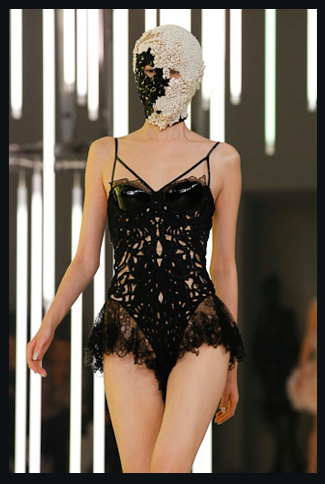
This is McQueen: SS12

I've still be thinking (perhaps too much) about this concept of people designing under the names of someone else. I neglected to mention in my last post how this can sometimes go shockingly right instead of dismally wrong (or artistically into left-field.)

In the case of Sarah Burton for Alexander McQueen, the act of taking over a name and continuing to design under it has gone as smoothly as Burton could have dreamed. But what's interesting about her takeover after the death of McQueen is how much she has been able to adhere to his previous aesthetic. This, I believe, is the key. There is no point is carrying on a fashion name when the new designer creates clothes that have nothing to do with the clothes that made that name famous. That's not to say that designers are without artistic license-- the very point of art is to innovate, but if that's the case, why not (as I mentioned previously) just start designing under your own name instead? Of course, this is much easier said that done, especially when a name like John Galliano carries the weight that it does.

At the same time, does this mean that Burton is resigned to design collection after collection that looks just as McQueen's last works did? No. Her work has moved in new directions, but what she has held onto is that eerie elegance, the evidence of a haunted genius that permeated McQueen's work. Not a problem, the pair worked together for over a decade before Lee's suicide. And, its pretty important to point out that this is only Burtons THIRD stand-alone collection. With the genius she displays, it seems like there have been many, many more before this. So why am I quick to dismiss Gaytten's work for Galliano but embrace Burton's work for McQueen? Because Burton's work oooozes McQueen, while Gaytten's work could be anybody for any name, but it's not necessarily Galliano. (Cue Enid telling Carrie "This isn't VOGUE!")

Burton described the line as "a collection about excess--an exploration of ideals beauty at their most extreme." McQueen's official twitter described the line as "hyper-feminitity." It's as though Burton has explored the boundaries of femininity to test how far it can go, how it can be emphasized. It makes use of feather and bird motifs as well as the ocean, sea shells, anemones, (the entire underwater theme is explored expertly by Vogue's review.)  This mingling of the strange with the ordinary creates looks that are haunting and mysterious in their effortless beauty. It's pointless to fit McQueen (really, ever) in with the other trends of Spring. It isn't like anything else.


Posted by: Carla 
*All images from Style.Com

Sunday, October 2, 2011

Can Anyone Do What John Does?

The Spring John Galliano collection differed from past lines when it was presented in Paris today. It was far less over the top than we might expect from a Galliano show, but the main departure was due to the fact that this this was the first John Galliano show with someone other than the brand's namesake at the helm. Bill Gaytten, who stepped in for Galliano when he was ousted at Dior and Galliano after his antisemitic tirade earlier this year. Dior has since been in the talks to find a new creative director (perhaps even Marc Jacobs) while the Galliano house seems to be sticking with Gaytten (despite a few less than savoury reviews.) 

It's difficult to help but wonder, in a line named for Galliano, can anyone do what John does? We've already mused the inherent problems of his genius when mingled with the fact that his actions have been, frankly, intolerable. But when we view art, and we know its been created by someone other than the man we've all lauded as a genius, can we still take it seriously? In a tangible sense, reviewers have noted that Gaytten's collections are simply not as outrageous as Galliano's, and that lack of ballsy genius is what makes them so much less exciting. Wall Street Journal blogger Christina Passariello muses that the less-than-lengthy legacy of Galliano's own brand (vs. Dior) allows Gaytten to branch out from what designers (in this case, Galliano) have done in the past. 

When viewing Gaytten's work, I almost find myself prejudicially dismissing it, because I know it's "not Galliano." That doesn't mean it's not good, but why, then, does the Galliano brand not just end with the demise of the shamed designer's career? Why doesn't Gaytten just strike out on his own, especially now that he must know he will never fill Galliano's shoes the way we want him to? In fact, it seems to me that Gaytten would garner more positive attention designing under his own name, because that "Galliano"-sized expectation would not exist. Indeed, it's not as though the two are strangers: Gaytten has been working with Galliano since his Givenchy days. And, obviously, there are millions of dollars to be made in Galliano's name, which is a shame, because this is not how art should work. 

Looking back at the designer brands that have survived from the early to mid 20th century, when international trade and fashion were flourishing, we still see names like Balmain, Rochas, Nina Ricci, Lanvin, Chanel and Christian Dior. But how many of the current creative directors of these companies design along the lines of the original Parisian creators? When Theyskin's took over the revived Rochas, he might not have known that Marcel himself was a reputed anti-semite, but what's more important is that articles discussing this revival said nothing about Rochas' original aesthetic and why that might be important to Theyskins (hence absolving him for overlooking Rochas' ideological shortcomings.) Sure, Olivier Rousteing is lauded for being a 25 year old design prodigy recently taking the reigns of Balmain, but what do his (albeit gorgeous) designs have to do with Pierre himself?

Does it matter what designers create in the name of someone else? Does the name stand for an aesthetic, or is it like fashion, changing with each day and season? Is it just about money? Is it as much an art form as we would like to argue or believe? Unfortunately for Gaytten, stepping away from John Galliano the brand, the name, and the man might be a bigger challenge than he can handle. 

Posted by: Carla 

Thursday, September 29, 2011

Balmain's Gold Glitters: SS12

One of my favourite bits of university research has been reading snippets of Pierre Balmain's autobiography My Years and Seasons. Balmain wrote about designing through the Occupation, working for Lucien Lelong and meeting another budding designer, Christian Dior. He talked about how they would hang out with Christobal Balenciaga and how he eventually decided to create his own fashion house. Balmain and Dior worked together at Lucien Lelong, and during Balmain's going away party, Dior had to leave because he was so upset. Nearly 70 years later, the House of Balmain is still going strong.


I feel as though I've said this a few times but Olivier Rousteing's Spring 2012 collection might be one of my favourite collections of the season. It was only April of this year that the 25 year old Rousteing was named designer at Balmain, replacing Christophe Decarnin. At this young age, Rousteing already had 5 years experience at Roberto Cavalli under his belt (as well as 2 years working under Decarnin.) Among others, New York Times magazine demonstrate some apprehension as to whether Rousteing would experience as much success has Decarnin has done as head designer at Balmain, but this Spring collection shows that Rousteing has the talent and the guts to pull off a well-tailored and ambitiously adorned line of women's clothing. 


At the same time, Rousteing isn't taking any huge steps away from Decarnin's previous aesthetic. Both are masters of cutting a fierce jacket, have a propensity for edgy rocker style, and Rousteing seems to be carrying on the smatterings of gold that Decarnin's made use of for a few seasons. (We all remember that infamous gold bathing suit that made covers on at least 3 international women's fashion magazines, yes?) 


Rather than give into the omnipresent colour and floral trends popping up all over spring runways, Rousteing seems to have instead opted to display a number of different textures and techniques. His work demonstrates an amazing amount of detail, rich use of gold, minimalist yet elegant use of blacks and whites, and even denim and quilting. Decarnin and Rousteing's Balmain lines have often been described as "rock and roll," but for some reason, both seem to have the ability to make rock and roll look effortlessly rich and put together. 


It was incredibly difficult to choose favourites, but here they are: 


Posted by: Carla


Thursday, September 8, 2011

Does antisemitism diminish genius? John Galliano only the latest in a long line of less-than-upstanding fashion designers.


I was upset to hear the news of John Galliano’s antisemitic tirade in a Parisian bar earlier this year. As a historian with a Master’s degree focusing largely on Nazi Germany and the Holocaust, I was obviously troubled by Galliano’s actions. At the same time, as a fan of both the House of Dior and the Galliano brand, I felt uncomfortable with my mind’s willingness to absolve Galliano’s actions simply because I believe him to be an artistic genius. 
When someone is an artist are we able to separate the creator from the man? Does the fact that Galliano has been found in a Parisian court to have committed antisemitic actions mean we must shun the art this man produces? In the end, is his art antisemitic if he is? I’m not sure. My inability to completely boycott all things Galliano adds to my discomfort. 
Still, the 6000 euro fine will hardly make a dent in Galliano’s pocketbook. This is, on paper, a classic case of the slap on the wrist. The maximum sentence for such a crime is a 22,000 euro fine and 6 months in prison. To some, particularly American observers, even this punishment is too much. Curtailing Galliano’s (drunken) rant is seen as an obstruction of his speech rights. However, most of these commentators ignore the context under which Galliano committed his “crime” and was charged. The French have felt their own discomfort at remembering the Occupation years and the tens of thousands of Jews that were sent by the collaborationist government to the Eastern European extermination camps. Antisemitism in this nation, with such a long historical record of religious and racial prejudice, is now taken at least a little more seriously. 
But Galliano hasn’t escaped his indiscretion with this verdict. He has lost his position as creative director for the House of Christian Dior as well as a stake in the company named for him. A few fashion industry friends like Kate Moss and Jean Paul Gaultier have stood by him, while others, like Natalie Portman, have publicly announced their disappointment. Galliano has even drawn the attention of the American watchdog group, the Anti-Defamation League. Essentially, Galliano’s reputation has undoubtedly suffered, as lawyer Yves Beddouk states, this public pillory is the “real punishment.” 
Galliano’s only released design of the year has been Kate Moss’ famed wedding dress. Of this project, Galliano states, “She dared me to be John Galliano again. I couldn’t pick up a pencil. It’s been my creative rehab.” 
Christian Dior himself mentioned in his memoirs that there were two Christians. One was born in 1947 with the advent of his famous “New Look,” and aesthetic that propelled Dior into the fashion limelight and Paris out of its Occupation slump. Dior’s contemporary, Italian-born Elsa Schiaparelli noted around the same time that “Schiap” was a famous designer, but that she was someone else. Schiaparelli often referred to “Schiap” in the third person as if talking about a completely different entity. Galliano’s feelings of distance from himself seem almost symptomatic of being such a famous figure. 
But then, his actions are not new either. During the Occupation of Paris Coco Chanel attempted to use the Nazi anti-Jewish laws to her favor to regain control of her company, Les Parfums Chanel, from two Jewish brothers. During this time, she was having an affair with a Nazi, Hans Gunther Von Dincklage. Her actions could certainly have been construed as antisemitic or even treasonous. Yet, despite a number of biographies revealing this information, the House of Chanel has remained nearly unscathed after all these years. Karl Lagerfeld, creative director at Chanel, has publicly denounced Galliano’s actions. 
Other famed Parisian designers like Marcel Rochas, Jacques Fath and Nina Ricci were rumored to socialize with the Nazis, all taking in Paris’ vibrant nightlight. Rochas was even said to have crossed the street to avoid passing Jews on the sidewalk. The House of Rochas has opened and closed throughout the years and in 2006, when the house of Rochas faced closure, New York Times magazine published a lengthy article on the current creative director, Oliver Theyskins. The article contains no mention of the man for whom the brand was named or any of the aesthetic styles that may have been characteristic to Rochas during the height of his success.

Two years later, when the House re-opened, the Wall Street Journal mentioned that Theyskins had moved onto to work at Nina Ricci, another brand named for a woman who was known to rub elbows with Germans.
Of course, the actions of Chanel, Rochas, Fath and Ricci can be attributed to the extreme circumstances of wartime. France has historically had a problem coming to terms with its somewhat collaborationist past, and the records of designers have not-so-mysteriously disappeared. But at the same time, fashion houses have become much bigger than the people for whom they were named. This is especially true of Chanel and Dior. But what of Galliano? His actions have put his face in newspapers around the world, drawing attention to him and not the brand he has created. He was ousted from the House of Dior and its collections have been released on time without him. 
We’ve been willing to forget the actions of designers whose indiscretions took place while the war was happening. No one knew how long the Occupation would last--survival seemed to be the most important factor, even if that meant accommodating the Nazi occupiers. In the earliest years of the war, it was still impossible to imagine the extent of Nazi terror. Now we know, and now we take antisemitism seriously.  For me, Galliano’s artistic genius and talent mean his designs are among my favorites, but I still can’t sort out in my own head how I feel about the man. 
As it turns out, this “ghost of himself” doesn’t seem to have figured it out yet either. 

Posted by: Carla 

Wednesday, July 13, 2011

Go to the record store, and visit your friends


Mikhail Baryshnikov (actually it was him playing Aleksandr Petrovsky, my all-time least favourite of Carrie Bradshaw's boyfriends) once said that Paris is the most magnificent city in the world.

He was right.

I've spent collectively perhaps 12 hours walking around Paris--Christian Dior once said the only wartime deprivation he didn't mind was the lack of fuel, because it meant people began to stroll around the city. It was like walking on a cloud. And I don't say this from the perspective of a wide-eyed Canadian girl who "loves" fashion. It was more than that. Being in a city like Paris reminds you that you will never hope to know all the legends who've walked those streets. Pierre Balmain and Christian Dior used to design in Paris together for Lucien Lelong and then they'd go spend time at Balenciaga's apartment. It was in paris that Chanel insisted on living throughout the occupation, to keep one eye on her #31 Rue Cambon boutique and another on a handsome German officer. Louis XIV visited Paris only a handful of times during his entire reign, but Margeret de Valois and Henry de Navarre were married there, at Notre Dame in 1572. It was a wedding that helped spark the St. Bartholomew's Day massacre. Mary, Queen of Scots was married in the same cathedral to Francis II. Paris is also where Napoleon I held his coronation, where he (and Jim Morrison) have been laid to rest, and where Hemingway liked to chill.  Gertrud Stein called it, simply, her hometown.

When the Nazis invaded and occupied the city, they planned not to squash Parisian culture, but to co-opt it. They wanted not to feel inferior to Paris but to call it their own. Oddly enough, I got to stand in the same spot as Hitler stood for his famous photo in front of the Eiffel Tower. For better or worse, this is a city full of history, culture, beauty and tragedy.

This long pre-amble is essentially my way of saying that since leaving France, I've experienced a huge jones for this city. The friends I went with were slightly less impressed (what can you expect from a group of 25 year old [straight] guys?) But I couldn't move past the fact that Paris is so old, and like a person, its lived a beautiful, long, complicated and often haunted life. Its cobblestones hold a million stories of the famous people who've walked along them, as well as those unknown people who call Paris home.

To aid both my Paris-jonesing and my poor French, I've been checking out a pretty great blog on Parisian street style. Thankfully, it isn't all always in French, but it has some pretty great street style shots (reasons we love Tommy Ton!) and if you look close enough (past the fabulous clothes) you can see tiny snippets of my favourite city.  So, Style and the City is pretty worth checking out, but then again, so is the real thing.

Posted by: Carla

Learning is Cool


I've spent the past few months studying fashion history (which is essentially the merging of two of my favourite things.) I wrote a paper on fashion in New York during the Second World War, and learned that it was because of the war that designers in New York finally got notoriety for their work and, for the first time, they were able to design clothes without having to depend on Parisian trends.

This semester I'm writing about the collaboration of French fashion designers in Paris during the Second World War. One thing I learned is that in the 1920s Coco Chanel signed a contract that had two investors, Jewish brothers named Wertheimer, pay into her perfume company, but it soon transpired that they made a lot of money off of the sales of Chanel No. 5.  When the Nazis occupied Paris in 1940, Chanel took advantage of the anti-Jewish laws and attempted to retake her company from the Wertheimer brothers. She didn't succeed, however, because the Wertheimers relinquished their shares to an "aryan," Felix Amiot.

More than this, however, I've recently learned that despite Chanel's less than honourable dealings with those she believed screwed her out of her own perfume company, she also had an affair with a Nazi named Hans Gunther von Dincklage (actually, this I had read before) but, none of this really mattered. Chanel closed the doors of her salon during the war, believing that no one would be selling couture during the war (they did) but the sales of Chanel No.5 continued to thrive. When the Nazis first occupied Paris, German soldiers lined up outside of the #31 Rue Cambon boutique to buy a bottle of the famous fragrance. When the stock sold out, they simply bought display bottles to have something to send home to their wives and girlfriends as souvenirs from Paris.

When the Allies retook Paris after the D-Day landings, American GIs took their turn to line up outside #31 Rue Cambon to buy Chanel No. 5 for their wives and girlfriends. Chanel's wartime lover was forced to retreat back to Berlin and, having lost touch with him, Chanel allegedly paid a German-speaking American GI with a duffel-bag full of Chanel No. 5 in exchange for the promise that if he heard anything of a von Dincklage or happened to come across the man in a camp he'd have him write Chanel a postcard. With a bag full of perfume, the GI essentially carried a fortune around with him--he could buy nearly anything on the black market with this unlikely currency.

So, despite her wartime dealings, Chanel's brand became bigger than she was. She put herself into exhile in Switzerland until 1952 and was not greatly loved when she returned to Paris, but her brand sold well all around the world. Chanel meant more than just Coco.

The questions I'm looking at with my current essay include first, what constitutes collaboration? Does Chanel sleeping with a German mean she collaborated? Did Lucien Lelong holding meetings with Nazis in order to keep the Parisian fashion industry in Paris rather than allowing it to be moved to Berlin mean he collaborated? Did Pierre Balmain and Christian Dior (allegedly) crafting gowns for the wives of Nazis mean they collaborated? I don't know. It's hard to say what we might do in those situations and there are a lot of factors to be considered.

Perhaps even more interestingly, this also speaks to the memory of the war. Do we judge Chanel more because she actually slept with the enemy, and do we judge women differently than men? In the context of the Second World War, women who slept with Germans were paraded through the streets having had their heads shaved and often their clothing taken. They were humiliated or even killed. The French have a difficult time in remembering their wartime experiences because collaboration was so widespread, and when we talk about fashion within that context, it leads to the question of whether we remember people like Chanel or Lelong more because they were famous, or less because collaboration was somewhat common. At what point do we begin to see collaboration from their point of view, within the contexts of their lives?

Anyways, that's what I've been working on lately.


Posted by Carla

Monday, January 24, 2011

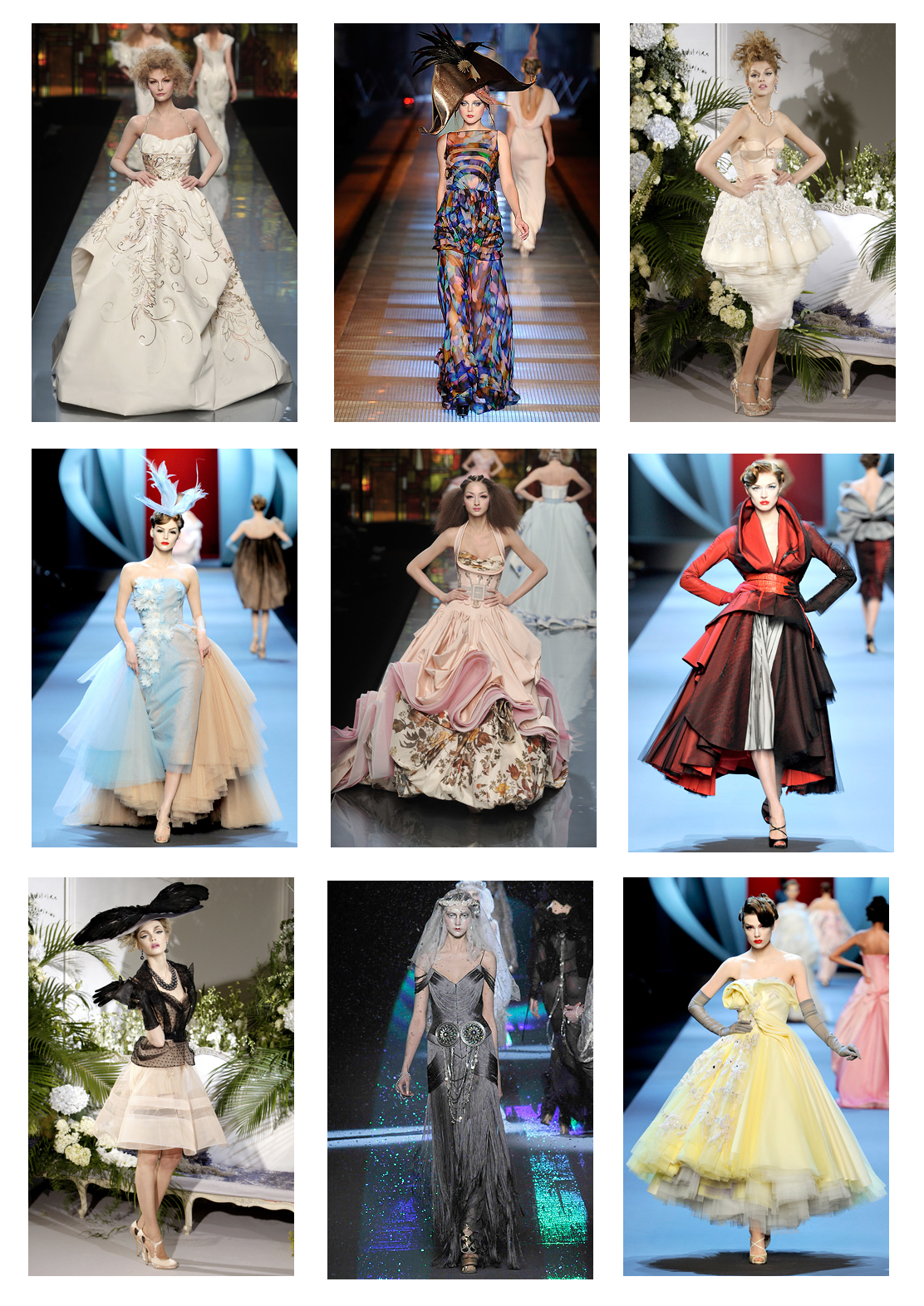
Christian Dior-Couture Spring 2011

During the Second World War, the American government introduced a provision called L-85, which restricted garments to specific silhouettes. Hence, through the first half of the 1940s, fashions were often tube shaped (straight down, without flouncing outwards) or made of cheaper materials. This was to conserve materials for the war effort and to instil a sense of duty for people on the homefront. However, in 1946, after having experienced the Second World War in occupied France, Christian Dior founded his own fashion house. A year later, he designed a dress that celebrated the hourglass shape of women, with a cinched waist and full tea-length skirt. He put an end to the conservative fashions that represented conservative wartime duty.

With his Spring Couture 2011 line, John Galliano for Christian Dior channels the same hourglass silhouettes and the decadent lines of the late Dior himself. What Galliano has created is a line of beautifully saturated colours, wonderful feminine silhouettes and over-the-top elegance and artistry that we come to expect from a couture line.  This 1930s and 1940s inspired collection, in my opinion, includes some of the most beautiful creations I've come across in some time, if ever.


Posted by: Carla

Thursday, November 25, 2010

Les Arts Decoratifs

Should you find yourself in Paris with nothing to do over the next few months, the museum of Les Arts Decoratifs is holding an exhibition on fashion (ready to wear as well as couture) of the entire decade of the 1990s. Although the uninitiated may remember the 1990s as a black hole in fashion, the museum (and I) see this period as one of the watersheds of modern fashion. This is when some of the most laudable designers we see today got their footing and began their style evolution.

Included in the exhibit are Azzedine Alaia, Balenciaga (Nicholas Chesquiere), Chanel (Karl Lagerfeld), Christian Lacroix, Jean Paul Gaultier, Christian Dior (John Galliano), Lanvin (Claude Montana and Alber Elbaz), Gucci (Tom Ford), Viktor and Rolf, Helmut Lang, Vivienne Westwood, Prada, Ann Demeuleester, Alexander McQueen and Issey Miyake.

The collection offers a glimpse into the artistic stylings of these designers, showing visitors their creative evolution through the 1990s, and elucidating how designers paid homage to their predecessors. Divided into categories of artistic styling and geography, the exhibition also hopes to show how these designers became front runners among their peers.


Posted by: Carla